
In the world of networking, Ethernet cables play a critical role in connecting devices and moving data reliably. With multiple categories available, ranging from Cat3 to Cat8, it can be difficult to determine which cable type is appropriate for a given environment.
Choosing the wrong category can limit performance or require costly upgrades later. For a broader understanding of how Ethernet cabling fits into overall network design, see our Comprehensive Guide to Network Cabling.
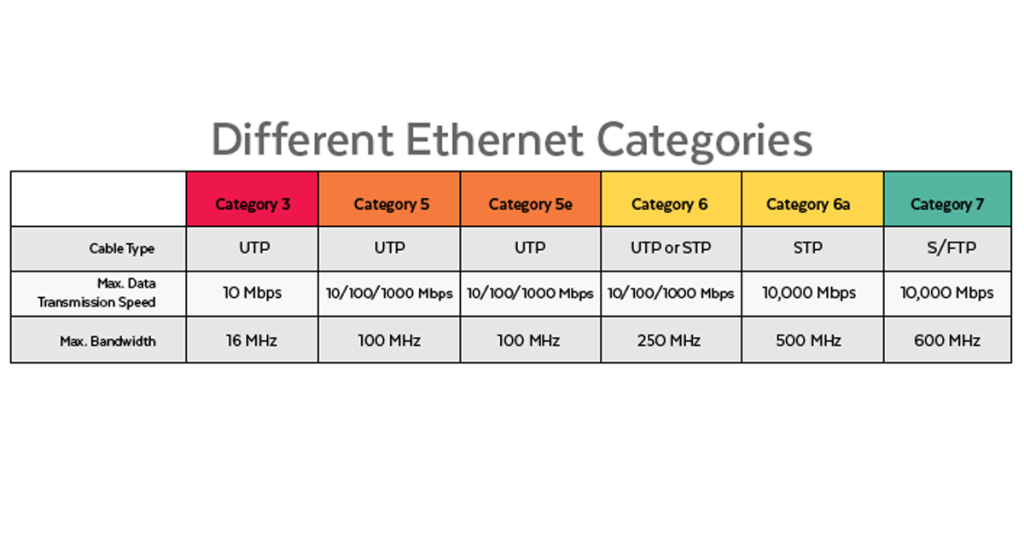
(Also, that comparison chart in your header image is good visual reinforcement. Shows speed, bandwidth, and shielding differences clearly. Keep that.)
Cat3
Cat3 cables were common in early networking environments.
• Supports speeds up to 10 Mbps
• Primarily used for voice and legacy data
• Mostly obsolete for modern networking
Today, Cat3 is typically only found in older telephone wiring and is not suitable for business networks.
Cat5
Cat5 improved on earlier standards and was widely adopted for early LAN deployments.
• Supports speeds up to 100 Mbps
• Common in older homes and offices
• Uses four twisted copper pairs
Cat5 is now largely outdated and replaced by higher-performance standards.
Cat5e (Enhanced)
Cat5e significantly improved performance over Cat5 and remains widely deployed.
• Supports speeds up to 1 Gbps
• Improved interference resistance
• Backward compatible with Cat5
Cat5e still works in many environments but may not meet future business demands.
Cat6
Cat6 offers higher performance and tighter installation specifications.
• Supports 1 Gbps at 100 meters
• Can support 10 Gbps at shorter distances (~55m)
• Common in modern business networks
Performance depends heavily on proper installation practices. Details like termination quality and twist preservation directly affect results, which we explain in Why the Twists in Cat6 Cable Matter More Than You Think.
Cat6A (Augmented)
Cat6A improves on Cat6 by supporting higher speeds over longer distances.
• Full 10 Gbps at 100 meters
• Better shielding against interference
• Thicker and more rigid cable
Cat6A is often chosen for new commercial builds or future-proof upgrades. We break down the practical differences in Cat6 vs Cat6A: Which Ethernet Cable Should Your Business Use?
Cat7
Cat7 cables provide increased shielding and higher frequency support.
• Supports speeds up to 10 Gbps
• Operates up to ~600 MHz
• Uses individually shielded twisted pairs (S/FTP)
Cat7 is less common in U.S. commercial installs due to connector compatibility and cost.
Cat8
Cat8 is designed for very high-performance environments.
• Supports 25–40 Gbps
• Limited to short runs (~30 meters)
• Typically used in data centers
Most business environments don’t require Cat8, but specialized applications may.
Choosing the Right Ethernet Cable
The right cable depends on more than speed ratings. Distance, interference, future growth, and installation quality all matter.
Many performance issues come from installation mistakes rather than cable category itself. We outline common pitfalls in Common Ethernet Cabling Mistakes That Hurt Network Performance.
For businesses, Ethernet cabling should be part of a structured infrastructure plan rather than a standalone decision. A properly designed system supports expansion and avoids costly rework, as explained in A Business Owner’s Guide to Structured Cabling (No Tech Jargon).
Planning a Professional Installation
If you’re planning network upgrades, new construction, or infrastructure improvements, visit our network cabling services page to learn how Cabling Wizards handles structured cabling design, installation, testing, and certification.
This post is an excellent guide for understanding the different types of Ethernet cables and their specific uses. The detailed breakdown of each category— from CAT3 all the way to CAT8—helps clarify the strengths and limitations of each type, making it much easier to choose the right cable for any networking needs. I especially appreciate the way the post explains the technological advancements in cable performance, from speed to bandwidth. It’s an invaluable resource for anyone looking to optimize their network setup or just better understand how Ethernet cables work!
This article provides a detailed and well-organized comparison of Ethernet cable categories, making it easy to understand the differences between Cat3 through Cat8. It’s a valuable resource for anyone looking to choose the right cable for their networking needs. Informative and well-explained!
A clear and insightful overview of Ethernet cable categories! You’ve really clarified how performance and use cases evolve from Cat3 up to Cat8, making it easy to choose the right cable for any network setup. A great resource for both beginners and pros.
Great overview! Your breakdown of each Ethernet cable—from Cat3 all the way to Cat8—makes it easy to grasp their strengths and ideal use cases. The clear explanations and helpful comparisons are much appreciated. Thanks for making network cabling this approachable!